Free online graph paper: draw on it or print it
Kallydo team · · Updated
You can draw on online graph paper for free on the Kallydo demo board. It opens an A4 page of graph paper in your browser, with no account and no sign-up, and you can draw on it straight away. If you would rather work on paper, the free printable PDFs below come with 5 mm, 1 cm and quarter-inch squares, and with numbered x and y axes.
What is graph paper?
Graph paper is paper printed with a grid of small squares, so you can draw to scale, plot points and read values off a graph. Most graph paper has a heavier line every few squares, which lets you count in fives or tens instead of counting every square. It is also called squared paper.
The grid is what makes a graph honest. A point plotted at (2, 3) on graph paper sits exactly where anyone else would read it, and a line drawn through plotted points shows its true slope. On plain paper both are guesses.
Which size of graph paper should you use?
Use 1 cm squares for younger students and for coordinates, 5 mm squares for most secondary school graphs, and quarter-inch squares if you are in the US, where four squares to the inch is the usual school size.
| Square size | Squares on one printed page | Good for |
|---|---|---|
| 1 cm | 19 across, 27 down (A4) | Coordinates, area and perimeter, first graphs. Big enough to write a number in a square |
| 5 mm | 38 across, 54 down (A4) | Graphs of equations and data, where the axes need a wider range |
| Quarter-inch | 30 across, 40 down (US Letter) | US school maths and science, four squares to the inch |
| 2 mm | About 105 across, 148 down (A4) | Precise graphs in science, reading values between the larger squares |
Kallydo's online graph paper is the 2 mm kind: small squares with a heavier line every 1 cm and a heavier one again every 2 cm, measured on the A4 page. So if you take one unit as 1 cm, each unit is five small squares, and you can still place a point between whole numbers.
How do you plot points on graph paper with x and y axes?
Draw a horizontal x-axis and a vertical y-axis that cross at the origin, (0, 0). Number the lines along each axis, then plot each point (x, y) by counting x units across from the origin and y units up or down.
- Draw the axes. Pick a heavier line near the middle of the page. Draw the x-axis across the page along it, and the y-axis up the page along another. Where they cross is the origin.
- Choose a scale and number the axes. One unit per 1 cm is the easiest to read. Number to the right and upwards with positive numbers, and to the left and downwards with negative ones.
- Plot each point. For (2, 3), start at the origin, count 2 units to the right, then 3 up, and mark a small cross. For (−1, −3), count 1 to the left and 3 down. Across first, then up or down: the x value always comes first.
- Label everything. Name each axis with what it measures, and give the graph its equation or a title.
How do you draw a straight-line graph?
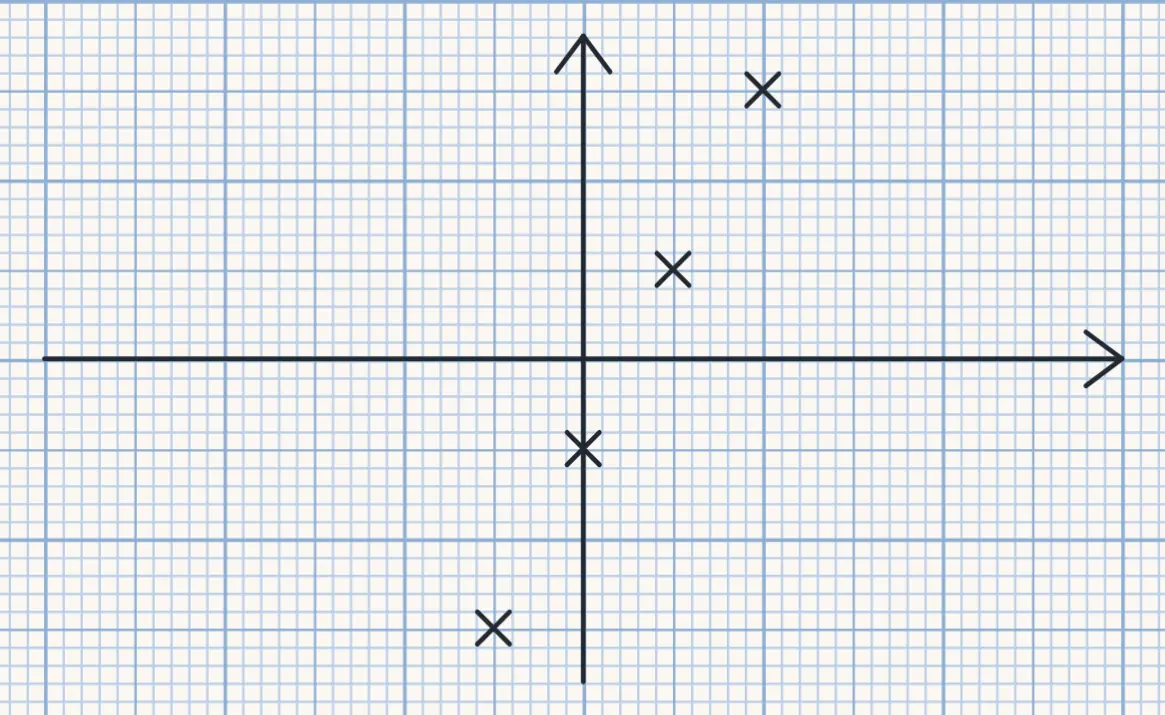
Make a table of values, plot the points, and join them with one straight line. For y = 2x − 1:
| x | −1 | 0 | 1 | 2 |
|---|---|---|---|---|
| y | −3 | −1 | 1 | 3 |
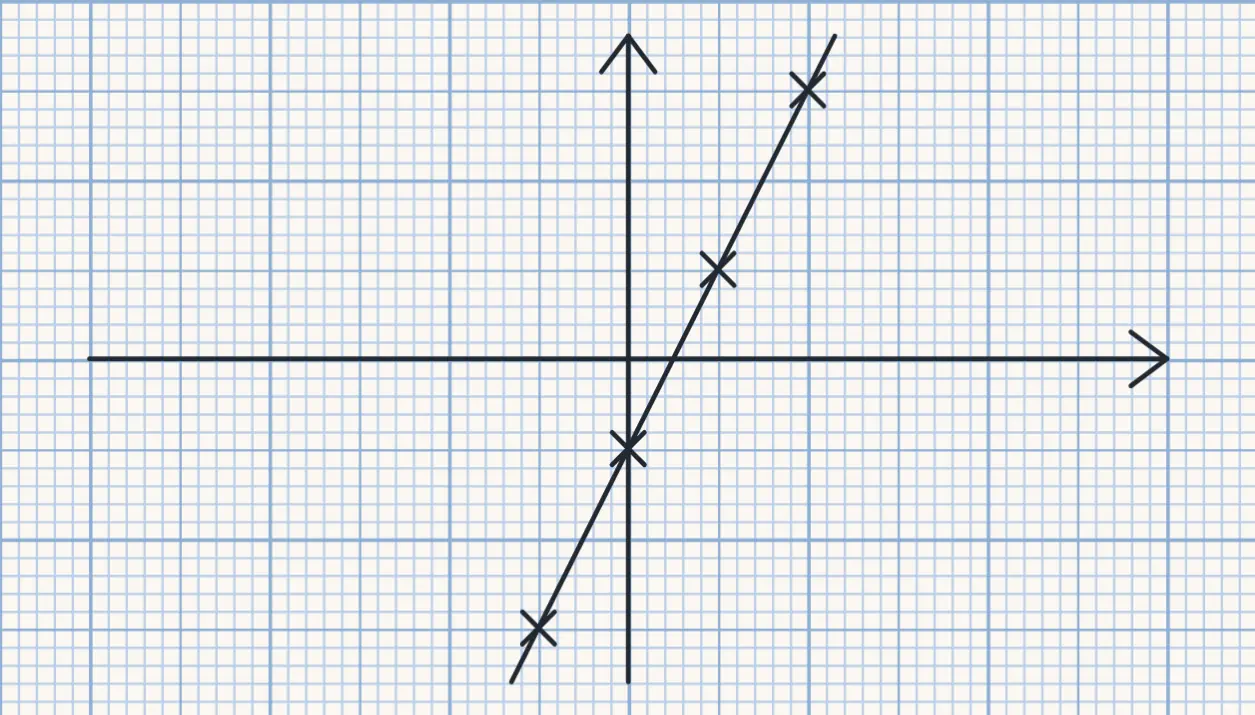
Plot (−1, −3), (0, −1), (1, 1) and (2, 3), then draw a single straight line through all four and a little past the end points. The graph at the top of this page is that line, drawn on the demo board.
Use at least three points. Two points always make a line, so a third is the check: if one point sits off the line, work out its y value again. A single stray point is nearly always an arithmetic slip, not a curve.
How do you get graph paper with axes and numbers?
Print one of the graph paper sheets with axes from the downloads below. Each has x and y axes through the middle and a number on every line: from −8 to 8 across and −12 to 12 up the A4 sheet, and from −6 to 6 across and −9 to 9 up the US Letter sheet. To work online instead, open the demo board and draw the two axes along heavier lines of its graph paper, as in the steps above.
Graph paper, grid, dot or isometric paper: which do you need?
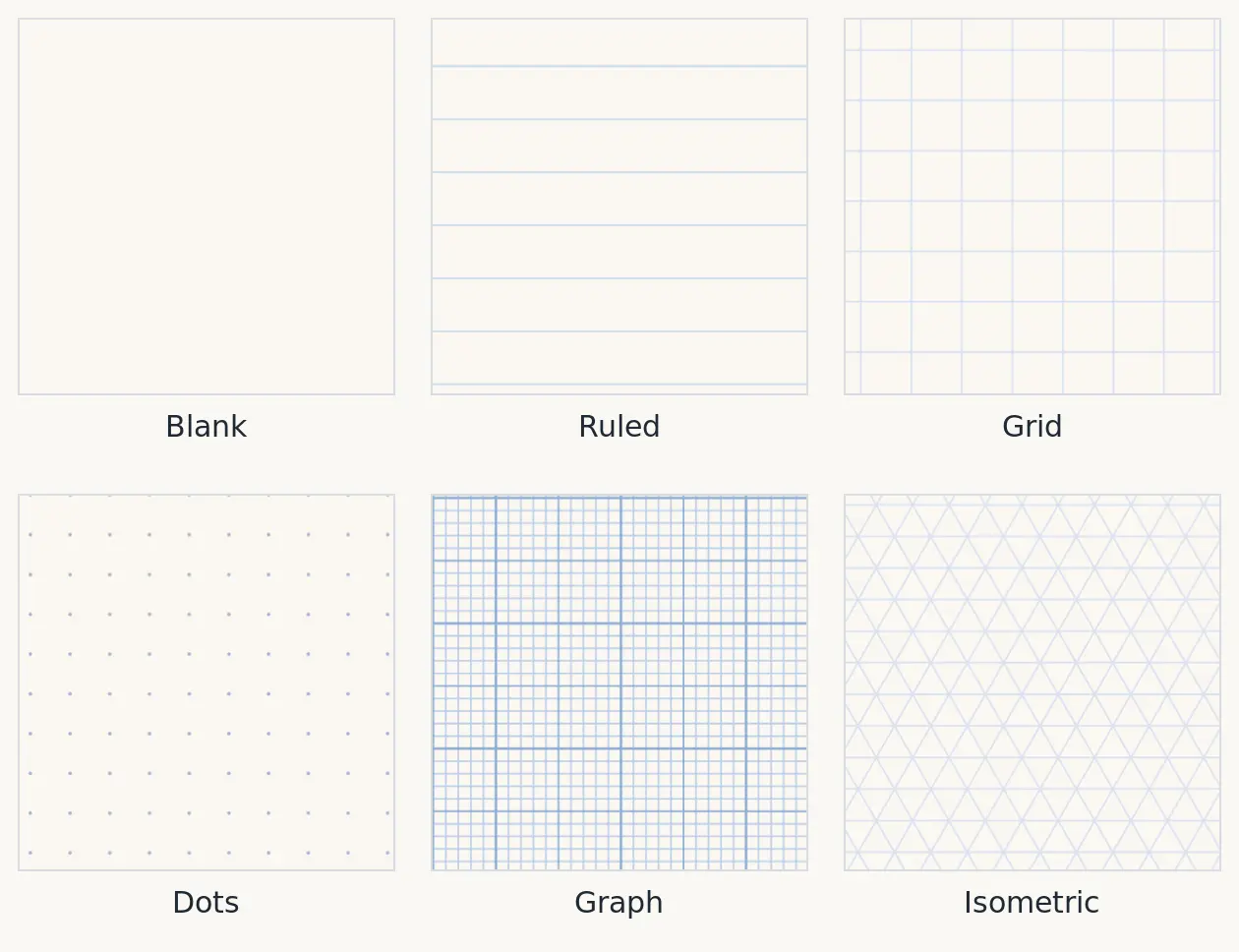
Use graph paper for anything plotted to a scale, grid paper for counting squares, dot paper for drawing shapes freely, and isometric paper for drawing 3D shapes.
| Paper | What it looks like | Use it for |
|---|---|---|
| Graph | Small squares, with heavier lines every few squares | Plotting graphs to a scale, reading values off a line, bar charts |
| Grid | Plain, larger squares | Coordinates, area and perimeter, transformations |
| Dot | A dot at each corner of the squares, no lines | Shapes, symmetry and nets, where lines would get in the way |
| Isometric | Lines, or dots, in a pattern of triangles | Drawing 3D shapes such as cubes and prisms |
Kallydo has all four, plus ruled and blank paper:
Isometric paper works differently from the rest: its lines run in the three directions of a cube's edges, so you draw along them rather than counting squares. The method is in how to draw an isometric drawing, step by step.
Download free graph paper PDFs
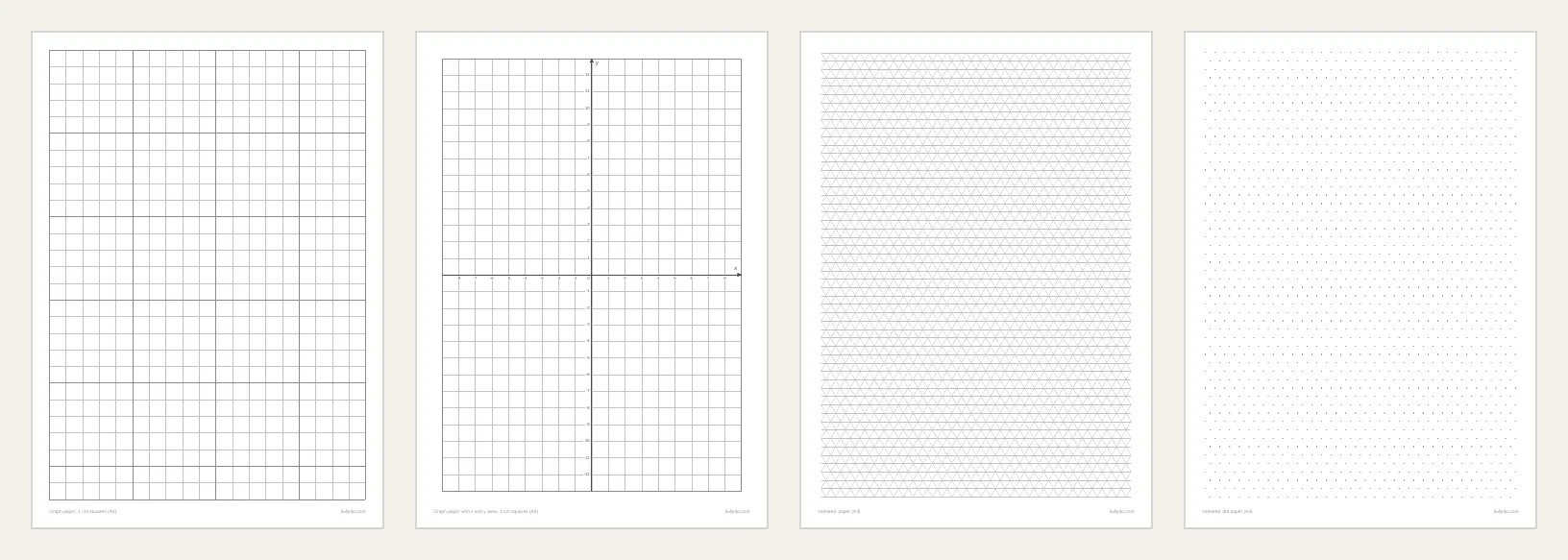
Each sheet is a free PDF: no sign-up and no email. Open it and print it, or save it to print later. The lines are light grey, so they guide the pencil without fighting with what you draw, and each sheet has a small kallydo.com in the bottom margin.
Graph paper
- Graph paper, 5 mm squares (A4, PDF), with a heavier line every 5 squares
- Graph paper, 1 cm squares (A4, PDF), with a heavier line every 5 squares
- Graph paper, quarter-inch squares (US Letter, PDF), with a heavier line every inch
Graph paper with x and y axes
- Graph paper with axes and numbers, 1 cm squares (A4, PDF)
- Graph paper with axes and numbers, half-inch squares (US Letter, PDF)
Isometric paper
- Isometric paper (A4, PDF) and isometric paper (US Letter, PDF)
- Isometric dot paper (A4, PDF) and isometric dot paper (US Letter, PDF)
The isometric sheets match Kallydo's isometric paper, with lines running across the page and at 60°. Turn the sheet a quarter-turn if you are used to isometric paper with vertical lines; the drawing method is the same.
How do you print graph paper at the right size?
Print at "Actual size" or 100% scale, not "Fit to page". Fitting to the page shrinks the whole sheet slightly, so a 1 cm square comes out a little under 1 cm and measurements taken from the printout are off.
How do you use online graph paper in a lesson?
Put graph paper on the page you teach from, draw the worked example while the student watches, and send them the page as a PDF or PNG when the lesson ends. In Kallydo every page has its own paper, so one lesson can have a ruled page for notes, a graph page for the worked example and a blank page for questions.
How do you choose the paper for a page?
- Select the page in the Pages list on the left, or add a new page with the + button.
- Open the paper menu by pointing at the paper button in the toolbar at the bottom of the board. The button shows the current paper, such as "Ruled".
- Choose the paper you want. The page changes straight away, and the choice is saved with it.
The choice applies to that page only, so the other pages in the document keep their own paper.
How do you send the page to students?
Export it. You can download a single page or the whole document as a PDF or a PNG image and send it the way you already share work. A PDF of a graph page prints at A4 with the graph paper behind your drawing, so a student can carry on working on the printout. The steps, and which option to pick, are in how to export a whiteboard page as a PDF or PNG.
Kallydo is in private beta. The demo board needs no account; signing in puts you on the waitlist for the full app, where your documents are saved to your account and synced across your devices.
Frequently asked questions
Is there free graph paper I can draw on online?
Yes. The Kallydo demo board opens on graph paper in your browser, free and with no sign-up. Draw with the pen, rub out with the eraser, and export the page as a PDF or PNG when you are done.
How do I get graph paper with axes?
Download the A4 or US Letter sheet with x and y axes already drawn and numbered. Online, draw the two axes yourself on the demo board's graph paper.
What size are graph paper squares?
There is no single standard. Metric graph paper usually has 5 mm or 1 cm squares, often with finer 1 mm or 2 mm squares in between for science; US school graph paper usually has four squares to the inch.
Can I print graph paper for free?
Yes. Every sheet in the downloads above is a free PDF with no sign-up or email. Print it at actual size so the squares come out the size the file says.