How much to charge for online tutoring
Kallydo team ·
There is no single going rate for online tutoring. What you can charge depends on your subject and level, whether students find you through a platform or on their own, and how much unpaid time sits around each lesson. This post gives the published numbers worth knowing and a way to set a rate of your own.
What do tutors earn?
Less than many people expect, if you look at employed tutors. The US Bureau of Labor Statistics puts the median pay for tutors at $20.84 an hour in May 2025. That figure does not include self-employed tutors, so it describes tutors who work for an employer, not tutors who set their own rates.
If you tutor through a marketplace, the platform takes a share. On Wyzant, for example, tutors keep 75% of their posted hourly rate and the platform keeps 25%. Wyzant also charges a 9% service fee on every lesson, so what a student pays and what you receive are further apart than your posted rate suggests.
| You post | Platform keeps (25%) | You receive |
|---|---|---|
| $40 an hour | $10 | $30 |
| $60 an hour | $15 | $45 |
The same help page notes one exception: a student you refer to Wyzant yourself pays you your full rate, with no platform share taken.
How do you work out your own rate?
Start from the market, then check that the number actually pays for your time.
- See what others charge for your subject and level. Look at 10 to 20 tutor profiles on two or three platforms, for the same subject, level and exam board as you. Note the middle of the range, not the cheapest or the most expensive.
- Count the time you are not paid for. Preparation, messages with parents, and writing up notes after a lesson all take time. If every hour of teaching needs half an hour around it, an hour's fee is really paying for an hour and a half.
- Work back from what you want to earn. Divide the amount you want per week by the hours you will actually teach, then add the time from step 2. For example, $600 a week from 15 lessons is $40 a lesson; if each lesson needs half an hour of preparation, that is $40 for 90 minutes of work.
- Add the platform's share, if you use one. To receive $40 an hour on a platform that keeps 25%, you need to post about $53.
- Compare steps 1 and 4. If your number sits far above the middle of the market, narrow your offer (a specific exam, a specific level) rather than cutting the price.
Should you charge per lesson or sell packages?
Both work; they suit different students.
- Per lesson is simplest for a new student and for occasional help before a test.
- A package of lessons, paid in advance, gives you a steadier week and fewer payments to chase. Some tutors offer a small discount for a block of 5 or 10 lessons.
- A short first lesson at a lower price, or free, lets a student and parent see how you teach before they commit.
Whichever you choose, write down a cancellation rule (for example, 24 hours' notice or the lesson is charged) and send it before the first lesson.
What should your rate include?
Everything the student gets, not only the hour on the call. A student who leaves with the worked examples from the lesson has something to revise from afterwards, and parents notice that.
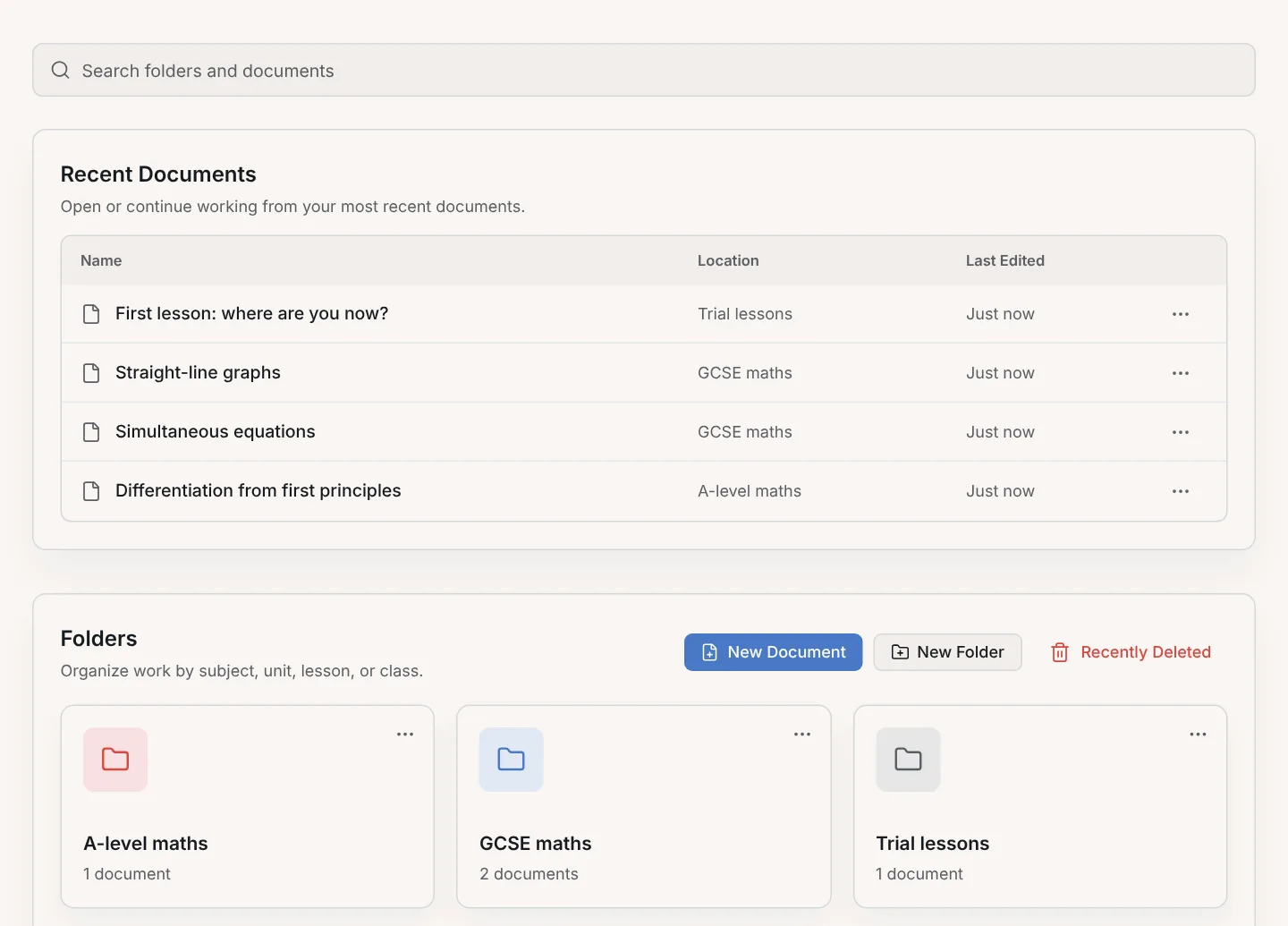
In Kallydo, a lesson is a document of A4 pages, and you can export a single page or the whole document as a PDF or PNG when the lesson ends. How that works is in how to export a whiteboard page as a PDF or PNG. Planning the business side as well, from finding students to the admin, is in how to start an online tutoring business.
When should you raise your rate?
When your week is full, or when you have a waiting list. The usual approach is to charge new students the new rate straight away and give current students a few weeks' notice before it applies to them.
Try the whiteboard your lessons would run on
The Kallydo demo board is a working whiteboard that runs in your browser, with no account and no sign-up. Draw a worked example on graph paper, then export the page, and you will see what a student could take away from a lesson with you.